
This asbestos survey case study covers a management survey we carried out at a small retail unit in Harrogate town centre – a good example of how a routine management survey on an unremarkable shop can still turn up a notifiable find. Identifying details have been removed.
Managing a shop, office or commercial unit? Call 07703 203930 or 07711 855891, or get a free quote below.
Get A Free QuoteThe Brief
The building is a ground-floor retail unit dating from around 1900, with a sales area, small kitchen, storeroom and WC on the ground floor, plus a cellar below. The client needed a management survey to establish a full asbestos register for the property – the standard starting point for any commercial duty holder wanting to demonstrate compliance with Regulation 4 of the Control of Asbestos Regulations 2012, rather than a survey tied to any specific renovation work.
What the Survey Found
The ground floor itself was largely unremarkable. Sales area, kitchen, storeroom and WC were all built out with modern boarding, plasterboard and floor coverings, and the one sample taken – vinyl floor tiles in the storeroom, partly hidden under a later floor covering – came back clear. On a building of this age, that’s not something you’d assume without testing, but it confirmed the ground floor posed no concerns.
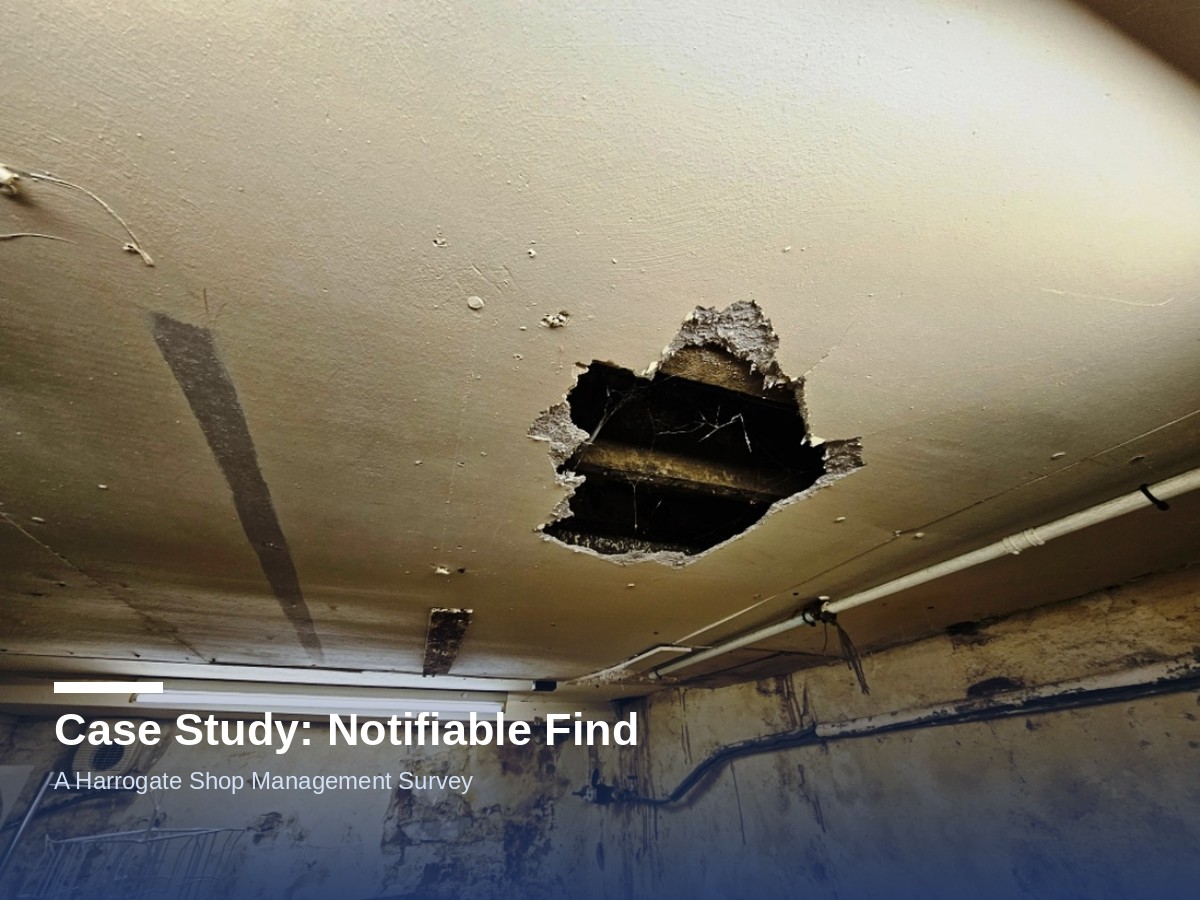
The cellar told a different story. The ceiling was asbestos insulation board, and a section of it had already failed – a visible hole with debris on the floor below. Lab analysis confirmed the board as amosite, brown asbestos, and the debris scattered across the cellar floor from the damaged section as the same material.
Why “notifiable” matters here
Asbestos insulation board is one of the material types that requires a licensed asbestos removal contractor, and any significant work on it triggers an ASB5 notification to the Health and Safety Executive at least 14 days before removal starts. That’s a meaningfully different process – and cost – to the kind of asbestos cement or vinyl tile removal that doesn’t require a license, which is why getting the material correctly identified at survey stage matters so much.
Got a damaged ceiling or unexplained void you’re not sure about? A management survey will tell you exactly what you’re dealing with.
Get A Free QuoteThe Outcome
The cellar was recorded as low risk overall, since it’s an infrequently accessed space, but the damage to the ceiling meant it couldn’t simply be labelled and left. Our recommendation was to restrict access, seal off the cellar and post warning signage until a licensed contractor could remove the affected board – with the debris on the floor needing the same controlled approach rather than being swept up as ordinary mess. Two smaller items – presumed asbestos textile tape on the fuse box, and a presumed asbestos textile and bitumen wrap on the incoming mains cable – were assessed as very low risk and can be safely labelled and managed in place, with a 12-month reinspection to confirm their condition hasn’t changed.
The client now has a complete register covering both floors, a clear licensed-removal action for the ceiling, and a straightforward management routine for everything else.
Areas we cover
We carry out management and refurbishment asbestos surveys across North Yorkshire, including Harrogate, the wider region, and the surrounding market towns.
Frequently Asked Questions
Do you publish real asbestos survey case studies like this one?
Yes – with identifying details removed to protect client confidentiality. They’re a useful way to show how findings can vary even within a small, straightforward-looking building.
What makes an asbestos find “notifiable”?
Certain higher-risk materials – asbestos insulation board, sprayed coatings, and lagging among them – legally require a licensed contractor and formal notification to the HSE before removal work starts. Lower-risk materials like asbestos cement generally don’t.
Does a damaged ceiling always mean immediate removal?
Not necessarily immediate, but it does usually mean restricting access and arranging removal promptly, rather than simply labelling it and leaving it as you might with an undamaged, low-risk material.
Think your building might have a similar issue? Call 07703 203930 or 07711 855891.
Get A Free Quote