
Asbestos Cement Explained
Got a corrugated garage roof, old cold water tank, or grey cement gutters? Get a free, no-obligation quote.
BOHS qualified surveyors covering Yorkshire, Lancashire, Greater Manchester and the wider North of England. Sampling and testing available, and we come to you.
Buildings Surveys & Assessment of ACMs
Management of Asbestos in Buildings
Surveying asbestos since the early 2000s
Low risk undisturbed, hazardous if broken or drilled
What Is Asbestos Cement?
Asbestos cement is made by mixing regular cement with around 10% to 15% asbestos fibres. Adding the fibres made the cement stronger, lighter, and fully weatherproof, which is exactly why it became such a popular building material through most of the 20th century.
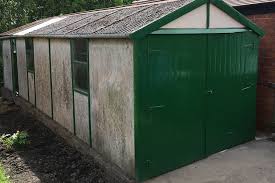
It was widely used in the UK right up until the late 1990s, especially for utility buildings, garages, sheds and outdoor fixtures. Because it is so durable, a very large amount of it is still in place today and remains in good condition, decades after it was installed.
Where You’ll Find It
- The Garage or Shed: Corrugated roofing sheets are the most common application, usually grey and wavy in profile.
- Outside the House: Rainwater gutters, downpipes, and soffit boards (the boards fitted under the edge of the roof) were all commonly made from asbestos cement.
- Inside the House: Old cold water tanks in the loft, flue pipes for boilers, and occasionally wall panels in bathrooms or behind heaters can also be asbestos cement.
Common Products Made from Asbestos Cement
Beyond roofing sheets, asbestos cement was formed into a wide range of building products, including drainpipes, sewer pipes, ducting, flat sheets and panels used for walls and ceilings, fencing, and roof and floor tiles. Its combination of strength, fire resistance and low cost meant it was used across almost every type of building, from private homes to factories, schools and farm buildings.
Planning to remove or replace a garage roof, gutters or an old water tank?
We are happy to give advice over the phone at no charge. No sales pressure – just straightforward guidance from qualified surveyors.
Is It Dangerous?
Asbestos cement is usually considered lower risk than other forms of asbestos, such as the fluffy lagging found wrapped around pipes.
- The asbestos fibres are tightly bonded, or locked, into the cement. Walking past an asbestos garage roof, or having an old cement water tank in the loft, does not release fibres into the air. In this undisturbed state, it is perfectly safe to leave in place.
- The risk comes if the cement is broken, drilled, sanded, or pressure-washed. If a sheet cracks or you use a power tool on it, the dust released can contain asbestos fibres that were previously locked safely inside.
How to Spot Asbestos Cement
Asbestos cement looks almost identical to modern fibre cement or concrete products, so it cannot be confirmed by sight alone. There are, however, a few signs worth looking out for:
- The Age: If the structure was built before the year 2000, it is highly likely to be asbestos cement rather than a modern equivalent.
- The Texture: One side is often slightly dimpled, similar to the surface of a golf ball.
- The Edges: Where the cement is chipped or broken, you may notice tiny white fibres protruding from the grey material.
What to Do If You Find It
If asbestos cement on your property is intact and undisturbed, the safest option is usually to leave it exactly as it is. Problems only arise when it is broken, drilled, sanded or pressure-washed, so avoid DIY work on suspected asbestos cement products until you know for certain what you are dealing with.
Removal of asbestos cement is classed as non-licensed work under the Control of Asbestos Regulations 2012, but this does not mean it is risk-free. It still requires a competent person using the correct PPE and wetting-down methods to avoid releasing fibres. If you are planning renovation, demolition, or replacement work involving anything you suspect might be asbestos cement, a sample tested at a UKAS-accredited laboratory will confirm exactly what you are dealing with before any work begins.
Get in touch with HSG Surveys today
Free advice. No-obligation quotes. BOHS qualified surveyors. UKAS-accredited laboratory testing.