
Most of our case studies show a survey working the way it should – commissioned before work starts, findings acted on, project moves forward. This one is different. It’s a case study in an asbestos survey and HSE prosecution running the other way round: our survey findings at a former retail unit on Hessle Road, Hull, went on to support a Health and Safety Executive investigation that ended in a guilty plea and a hefty fine. Because the case is a matter of public record, we can go into more detail here than usual. 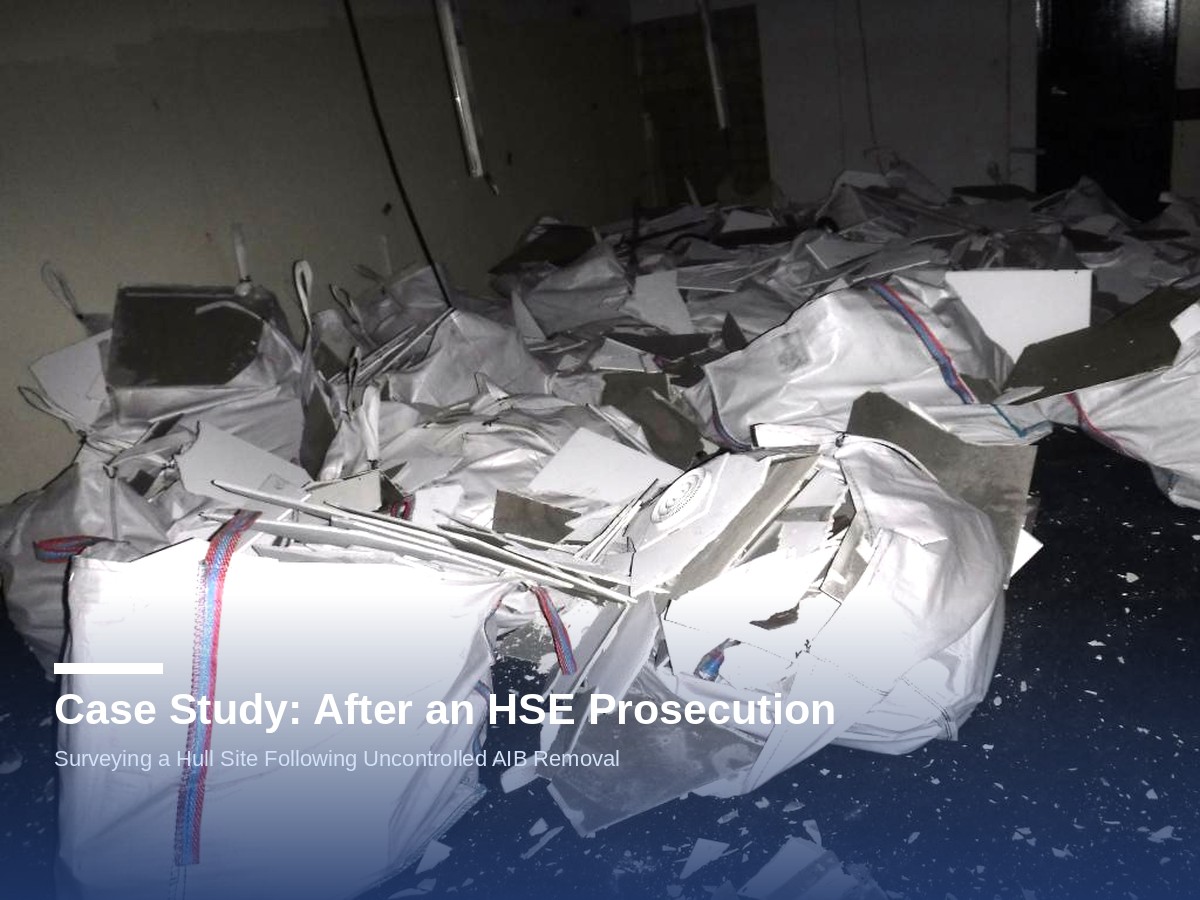
Refurbishing a commercial building without a survey in place? Call 07703 203930 or 07711 855891, or get a free quote below. Get A Free Quote
What Happened on Site
In March 2019, the owner of the property was converting the ground floor into separate retail units and needed the old suspended ceiling removed to make way for new stud partitions. No refurbishment and demolition survey was commissioned before work began. Untrained casual labourers spent three to four weeks stripping out the ceiling by hand, using claw hammers on tiles that turned out to be asbestos insulation board – over 1,000m² of it. The HSE’s subsequent investigation found the company had not passed on any information about asbestos to the people doing the work, because none had ever been established in the first place. The company later pleaded guilty to breaching Regulation 5 of the Control of Asbestos Regulations 2012 at Beverley Magistrates’ Court, and was fined £16,000 plus costs and a victim surcharge.What the Survey Found
We were instructed to carry out a full refurbishment and demolition survey once the HSE investigation was underway, to establish exactly what the workers had been exposed to and what remained on site. The scale was significant: roughly 1,760m² of AIB ceiling tiles across the ground floor, with the two main retail areas extensively contaminated from the uncontrolled strip-out. The ceiling frame was still in place with fragments of board attached throughout, floors were covered in debris, and around 62 tonne-bags of bagged material were already sitting on site. A further 600m² of heavily contaminated carpet was still down, with loose rolls of more removed nearby – roughly 1,058m² of contaminated carpet in total. Lab analysis confirmed amosite and chrysotile in the ceiling tile material throughout, plus presumed crocidolite in textile flash pads at several fuse boxes and a cement flue – all consistent with a building of this age that had never had its asbestos properly identified before work began.Setting up for the HSE inspection
Because the contamination was so extensive, part of our job was making the site safe enough for HSE inspectors to access and investigate. We set up a decontamination unit and an airlock so the investigation could proceed without spreading contamination further or putting inspectors at risk – effectively treating the whole ground floor as a live asbestos area until it could be properly assessed and controlled.Dealing with a site that’s already been disturbed? We can assess the scale of contamination and get it safely under control. Get A Free Quote
The Wider Point
The entire incident, and the resulting fine, could have been avoided with a single refurbishment survey booked before anyone picked up a hammer. As the investigating HSE inspector put it afterwards, identifying the asbestos through a proper survey and having it removed by a licensed contractor would have meant nobody was exposed at all. That’s really the lesson of this case study: a survey costs a fraction of what uncontrolled removal, HSE investigation, and prosecution end up costing – in money, in disruption, and in the health risk to whoever’s holding the hammer.Areas we cover
We carry out refurbishment and demolition surveys across East Yorkshire, including Hull and the surrounding docklands and industrial areas.Frequently Asked Questions
What happens if asbestos work has already started without a survey?
Work should stop immediately. A survey is then needed to establish the extent of any contamination before the area can be made safe, cleaned, and any remaining asbestos properly removed.Can HSE prosecute a company even after the work is finished?
Yes – as this case shows, an investigation and prosecution can follow well after the exposure took place, based on evidence gathered on site and from those involved.Is this level of contamination unusual?
It’s at the more serious end of what we see, but uncontrolled removal by untrained labour is a recurring pattern behind the worst cases – which is exactly why a survey before work starts is a legal requirement, not just good practice.Details of the HSE investigation and prosecution referenced in this case study are a matter of public record, reported by the Health and Safety Executive following the hearing at Beverley Magistrates’ Court.
Don’t let a refurbishment become an HSE case study. Call 07703 203930 or 07711 855891.
Get A Free Quote