
Not sure if a material in your building contains asbestos? Get a free, no-obligation quote.
BOHS qualified surveyors covering Yorkshire, Lancashire, Greater Manchester and the wider North of England. UKAS-accredited laboratory testing available.
Buildings Surveys & Assessment of ACMs
Management of Asbestos in Buildings
Surveying asbestos since the early 2000s
Lab-confirmed results, not guesswork
What Are Asbestos Containing Materials?
Asbestos containing materials, often shortened to ACMs, are building products that were manufactured with asbestos fibres for strength, fire resistance or insulation. If your property was built or refurbished before the year 2000, it is likely to contain at least one of them somewhere in its structure.
Under the Control of Asbestos Regulations 2012 (CAR 2012), any such material must be presumed to contain asbestos unless proven otherwise. So, before any renovation, maintenance or demolition work begins, identifying asbestos in buildings is the essential first step in staying compliant and keeping everyone on site safe.
This guide groups the most common types of asbestos materials by how easily they release fibres, and where you’re likely to find them.
High-Risk and Friable Asbestos Containing Materials
These materials release airborne fibres readily if disturbed, and removal usually requires a licensed contractor.
- Sprayed Asbestos Coatings: Used historically for structural fireproofing and acoustic insulation in industrial plant rooms. These can contain up to 85% asbestos and are highly friable.
- Asbestos Lagging and Pipe Insulation: Found wrapped around thermal systems and boilers, often as a fibrous wrap or plaster-like coating. High risk, both because of its asbestos content and its tendency to degrade into dust over time.
- Asbestos Insulation Board (AIB): Frequently mistaken for ordinary plasterboard, AIB was widely used in fire breaks, partition walls and ceiling tiles. It is more brittle than plasterboard and releases fibres easily if drilled, cut or impacted.
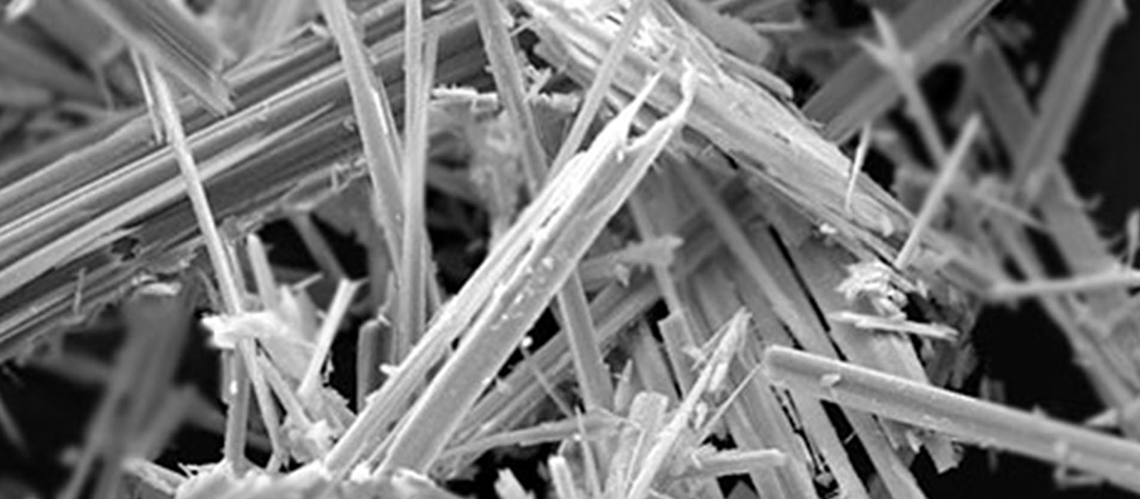
Raw Amphibole Asbestos Fibre Needle Like
Bonded and Lower-Risk Asbestos Materials
By contrast, these ACMs bind the fibres more tightly, so they present a lower risk unless they’re worked on aggressively.
- Asbestos Cement Products: The most common ACM in UK buildings. Typically found as corrugated garage roofing, external cladding, and drainage components such as gutters and downpipes.
- Textured Coatings (including Artex): Popular as a decorative finish through the 1970s and 1980s. Asbestos content is usually low, around 1 to 5%, but sanding or scraping during renovation can still release fibres.
- Thermoplastic Floor Tiles and Bitumen Adhesives: Common in mid-century schools and offices. The black bitumen adhesive underneath vinyl floor tiles is a frequent source of hidden asbestos.
Found something you think might be asbestos?
We are happy to give advice over the phone at no charge. No sales pressure – just straightforward guidance from qualified surveyors.
Comparing the Risk Level of Common ACMs
So how do these materials stack up against each other? The table below gives a quick at-a-glance comparison.
| Material Type | Common Location | Risk Level | Removal Requirement |
|---|---|---|---|
| Sprayed Coating | Steelwork / Plant Rooms | Extreme | Licensed removal |
| AIB | Ceiling Tiles / Soffits | High | Licensed / notifiable |
| Cement | Garage Roofs / Flues | Medium / Low | Non-licensed (task-dependent) |
| Floor Tiles | Vinyl Flooring / Adhesives | Low | Non-licensed |
Why You Can’t Identify ACMs by Eye
Asbestos cannot be identified by sight alone. Many ACMs look identical to modern synthetic materials, and the only reliable way to confirm one is laboratory analysis.
As mentioned above, Regulation 4 of CAR 2012 (the Duty to Manage) requires property owners and duty holders to presume a material contains asbestos unless a UKAS-accredited laboratory has proven otherwise.
Next Steps for Compliance
Once you suspect ACMs are present, there are three routes forward depending on what you’re planning to do with the building:
- Commission a Management Survey: For ongoing occupational safety in an occupied building. Read more about Management Surveys.
- Commission a Refurbishment or Demolition Survey: Mandatory before any intrusive structural work on a pre-2000 building. Read more about Refurbishment & Demolition Surveys.
- Arrange Laboratory Sampling: Uses polarised light microscopy (PLM) to confirm whether a specific material contains asbestos fibres. Read more about Sampling & Testing.
Whichever route applies to you, getting a proper asbestos survey from a BOHS-qualified surveyor is the safest and most cost-effective way to identify asbestos containing materials before work starts, rather than finding out the hard way once it’s already disturbed.
Get in touch with HSG Surveys today
Free advice. No-obligation quotes. BOHS qualified surveyors. UKAS-accredited laboratory testing.